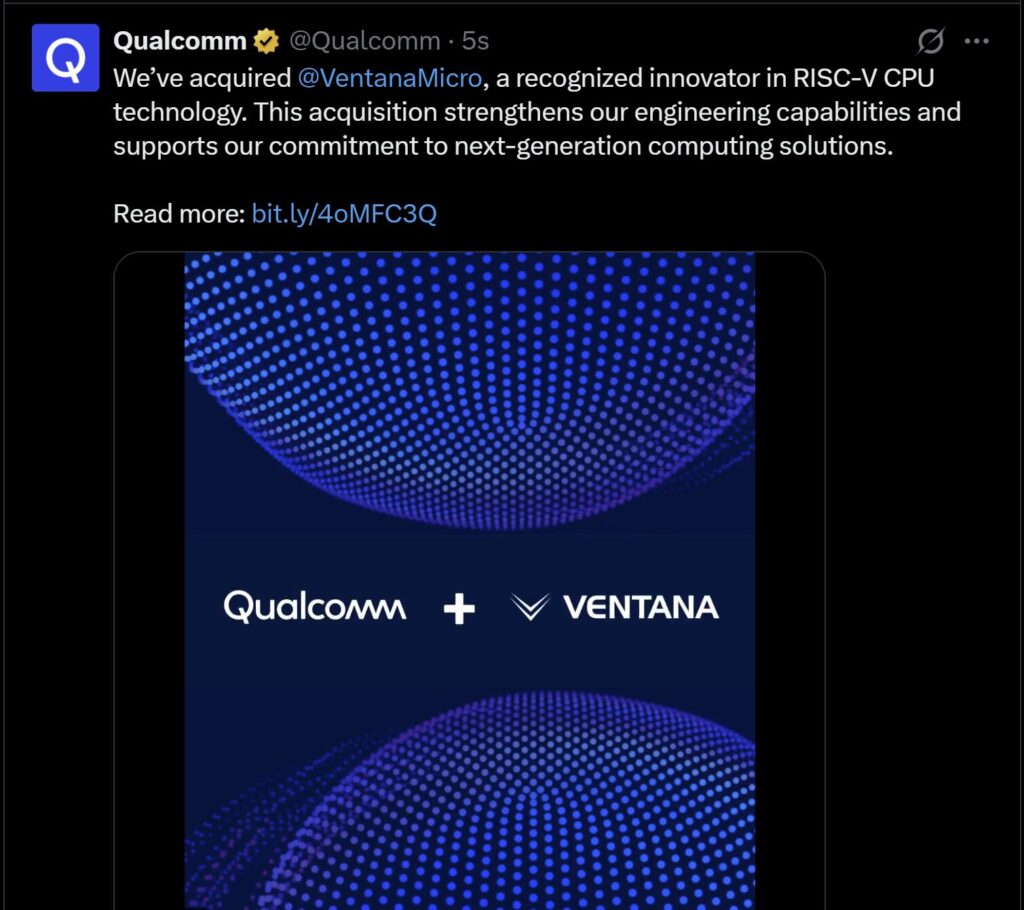
Today, Qualcomm formally announced the acquisition of Ventana Micro Systems, a calculated move to bolster its next-generation CPU roadmap and increase its RISC-V technology capabilities. Innovation in custom processor platforms like Oryon and next Snapdragon families should be further stimulated by this.
Qualcomm now has a solid technical base to incorporate RISC-V advances with its current unique CPU architecture thanks to this acquisition. This aims to create more secure, scalable, and power-efficient CPUs for data centers, AI applications, and mobile devices.
According to Qualcomm, a number of ongoing internal projects, including as the internally created Oryon CPU series, will be directly supported by Ventana’s RISC-V expertise. Qualcomm is attempting to increase instruction-level efficiency and lower power consumption across future platforms by fusing the open and modular design of RISC-V with the performance-focused engineering of Oryon. This would facilitate multi-year development for enterprise-level AI applications, edge computing devices, and smartphones.
Key strategic benefits include:
- Better integration between RISC-V and proprietary CPU designs
- Improved low-power and high-performance computing capabilities
- Faster mobile and AI-focused silicon innovation cycles
What this means for Snapdragon flagship devices
Xiaomi’s premium device ecosystem will be directly impacted by this acquisition, particularly in models that use Qualcomm’s high-end chipsets. The ongoing Oryon development strategy is tightly linked to the Snapdragon 8 Elite, which powers advanced platforms.
Future Xiaomi products, such as the Xiaomi 15 series and an anticipated Xiaomi 17 series, will follow this architectural progression. These can result in more consistent gaming and multitasking experiences, enhanced AI processing, and greater sustained performance. These CPU-level improvements are also anticipated to help devices with the POCO F7 Ultra and upcoming POCO F8 Ultra, which rely on flagship platforms from China that have been modified for the international market.
Expected benefits for the Xiaomi smartphones include:
- Higher sustained performance under heavy workloads
- Improved battery efficiency in AI and gaming scenarios
- More consistent thermals for flagship-class devices
How Ventana is driving the next wave of RISC-V innovation
With its headquarters located in Cupertino, Ventana Micro Systems was established in 2018. It focuses on creating safe, scalable, high-performance chiplet solutions built on the RISC-V open architecture. By participating in RISC-V International’s several technical steering groups, the company actively contributes to the development of industry-wide standards.
RISC-V has a lot of potential to spur additional innovation in future CPUs, according to Durga Malladi, Executive Vice President and General Manager for Technology Planning, Edge Solutions, and Data Center Business at Qualcomm. Ventana CEO Balaji Baktha promised that the team would now collaborate closely with Qualcomm, incorporating its knowledge into Oryon-based systems aimed at advances in low-power, high-performance computing for next consumer and business devices.