

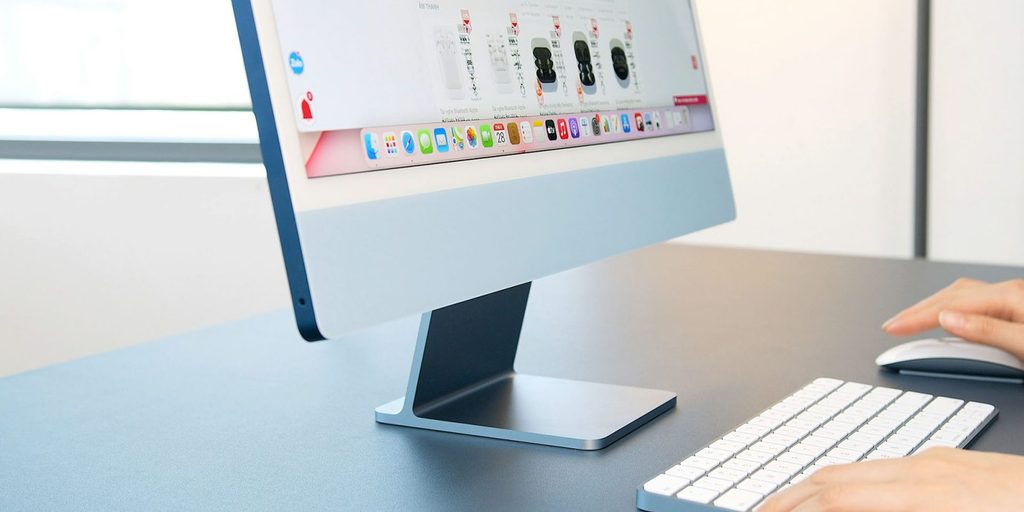
Apple is exploring an OLED display for future desktop computers, though an OLED iMac remains several years away from release. Mark Gurman reported on Bloomberg’s Power On podcast that the company has begun investigating the panel technology for its all-in-one line. The report follows the recent arrival of the 2026 iMac, which introduced the M6 processor, improved wireless connectivity, and faster artificial intelligence processing. While those internal hardware updates delivered performance gains, the computer retained the exterior design established during the 2021 transition to Apple silicon, leaving desktop users waiting for a substantial hardware redesign.
Desktop panel costs and positioning
Gurman noted that preparing an organic light-emitting diode screen for the desktop will take considerable time before reaching market. “Yeah, that would sell really well, but they are looking at an OLED iMac, that I can tell you as well, but I still think that’s a few years away. Okay, so maybe that’s the next big change,” Gurman said during the discussion. Bringing OLED technology to desktop computers presents notable pricing challenges. Mainstream all-in-one computers typically sell for $1,200 to $1,500, a range where OLED displays remain rare. Such an upgrade would push the desktop into luxury pricing, making it plausible that Apple could reserve the panel for a rumored 27-inch model or a revived iMac Pro.
Apple’s broader shift toward OLED displays
Over recent years, Apple has leaned heavily on transitioning its product lineup to OLED panels. That hardware progression began on iPhones and Apple Watches before expanding to tablets, where the M4 iPad Pro was the first iPad to adopt the screen technology. The iPad mini and the OLED MacBook Pro followed with similar display upgrades. Bloomberg previously reported that the iPad Air is next in line to receive an OLED screen, and the company may eventually bring an OLED panel to the MacBook Air as well.
The iMac itself has seen little external evolution since Apple introduced the M1 redesign in 2021. Ever since that transition, the physical chassis and color options have remained more or less identical across generations. Apple has treated internal silicon as the primary area of change, and the 2026 release with the M6 chip continues that exact trend. Whether the company decides to release a larger screen first or rebuild the all-in-one desktop from the ground up remains unannounced, leaving the timeline for an OLED refresh unsettled.
Editorial Ethics & Disclosure: Our evaluations, reviews, and reporting are conducted independently. Learn more about our editorial ethics and affiliate disclosures.

About Robert Haba
Robert Haba covers technology, hardware architectures, and consumer platforms for Gadgetts.
Related Coverage
 Laptops & PCs
Apple claims Safari battery life beats Chrome by five hours on MacBooks
Apple claims Safari battery life delivers up to five extra hours of video streaming on MacBook Air laptops compared to Google Chrome.
 Laptops & PCs
Finding an Intel equivalent to Apple M5 processors
Comparing benchmark scores reveals where an Intel equivalent to Apple M5 silicon exists in laptop chips, while M5 Max and Ultra maintain performance leads.
 Laptops & PCs
How a $10 bootable USB drive can rescue a failing PC
A $10 bootable USB drive can recover an unbootable PC. Learn how to configure Ventoy with Windows or Linux ISO files and portable repair tools.