

Xiaomi is closing out the year with fresh Poco flagships and a huge HyperOS 3.0 update based on Android 16. From new phones to a revised UI, here’s what’s rolling out and when you can expect it on your smartphone.
Xiaomi has more phones to release this year. The worldwide versions of the Poco F8 Pro and F8 Ultra were just released. The company has revised the HyperOS 3.0 deployment schedule, which is now expected to reach over a dozen Poco phones and tablets, in tandem with the surge of new hardware.
The new Poco F8 Pro and Poco F8 Ultra flagships ship with Android 16 out of the box. Other models will be released on a staggered schedule.
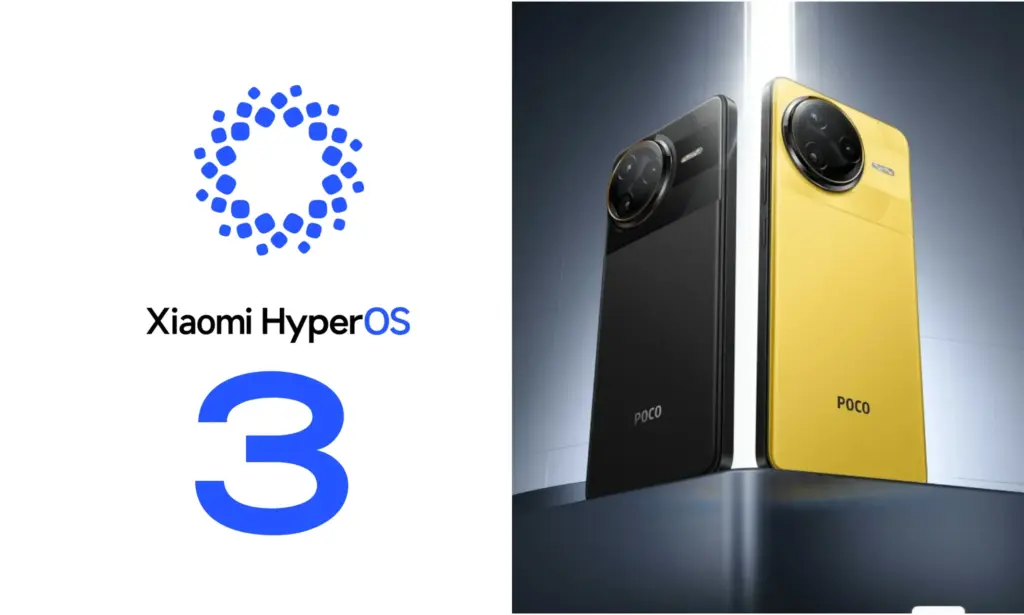
Which Poco devices are confirmed to get HyperOS 3.0
For the initial group of Poco devices, the deployment started in October and will last until the end of November. The Poco F7 and X7 series from the previous year, including its Ultra variants, are at the top of the list. Some users outside China have already reported receiving the software. However, it’s not uncommon for other devices to only receive notifications in the upcoming days, depending on variations.
The Poco F6 (Pro), Poco X6 Pro, Poco M7, Poco M6 (Pro), and Poco C75 will lead the following batch in December.
Between December 2025 and March 2026, a broader release that includes the Poco F5 (Pro), Poco X6, Poco M7 Pro, and Poco C85 is scheduled. Poco’s Android tablets, such as the Poco Pad, Poco Pad X1, and Poco Pad M1, will join these. Regretfully, Xiaomi has not disclosed the timing for every device.
What’s new in HyperOS 3.0?
HyperOS 3.0 is built on Android 16, which adds its own set of new features and customizations. Xiaomi’s version offers a substantial user interface overhaul, increased security, and superior optimization for longer battery life and smoother performance.
The most noteworthy graphic modification is Super Island, inspired by iOS’s Dynamic Island. As a native feature of Android 16, it is integrated into the punch-hole camera region and shows live updates and dynamic widgets.
The main UI has also been overhauled with transparent parts, blurred backgrounds, and redesigned app icons. Users receive new styles on the lock screen, like as live effects and AI-generated wallpapers.
Additionally, Xiaomi promises enhanced usability and performance. Multitasking and app switching are stated to be snappier, while overall responsiveness is quicker.
Permission limits and improved data protection have improved security. In other areas, HyperOS 3.0 provides closer connection with Xiaomi’s wider range of products.
Editorial Ethics & Disclosure: Our evaluations, reviews, and reporting are conducted independently. Learn more about our editorial ethics and affiliate disclosures.

About Robert
Robert Haba is a tech writer and gadget enthusiast at Gadgetts, covering the latest in consumer electronics, smart devices, and emerging technology. With a passion for hands-on testing and honest, no-fluff reviews, Robert helps readers make smarter buying decisions. When he's not unboxing the newest tech, he's deep-diving into how everyday gadgets can make life a little easier.
Related Coverage
 Laptops & PCs
How a $10 bootable USB drive can rescue a failing PC
A $10 bootable USB drive can recover an unbootable PC. Learn how to configure Ventoy with Windows or Linux ISO files and portable repair tools.
 Laptops & PCs
Asus TUF Gaming A15 2026 arrives with Ryzen 7 170 and RTX 3050
The Asus TUF Gaming A15 2026 lists for ₹97,990 on Amazon with an AMD Ryzen 7 170 chip, RTX 3050 graphics, 16 GB DDR5 RAM, and a 144 Hz FHD display.
 AI
Evidence suggests Google may pair Gemini 4 Flash and Carbon in an upcoming release
Developer logs and benchmark shifts suggest Google may pair Gemini 4 Flash and Carbon, combining speed and advanced reasoning across test environments.