

Matching Apple silicon against Intel hardware requires looking at specific product tiers, because Apple divides each generation into baseline, Pro, Max, and Ultra processors. Determining an Intel equivalent to Apple M5 hardware depends heavily on whether the workload prioritizes single-threaded responsiveness or multi-core throughput. In portable computers, the standard M5 lines up against Intel Core Ultra laptop processors such as the Ultra X9 388H and Ultra X7 358H. System designers target both chip families at the same general laptop segment, balancing snappiness and reliability for day-to-day productivity with adequate power for media entertainment and light gaming without excessive power draw. In Apple’s lineup, even entry-level M5 configurations exhibit slight differences between MacBook Air releases, though those hardware variances affect only graphical performance.
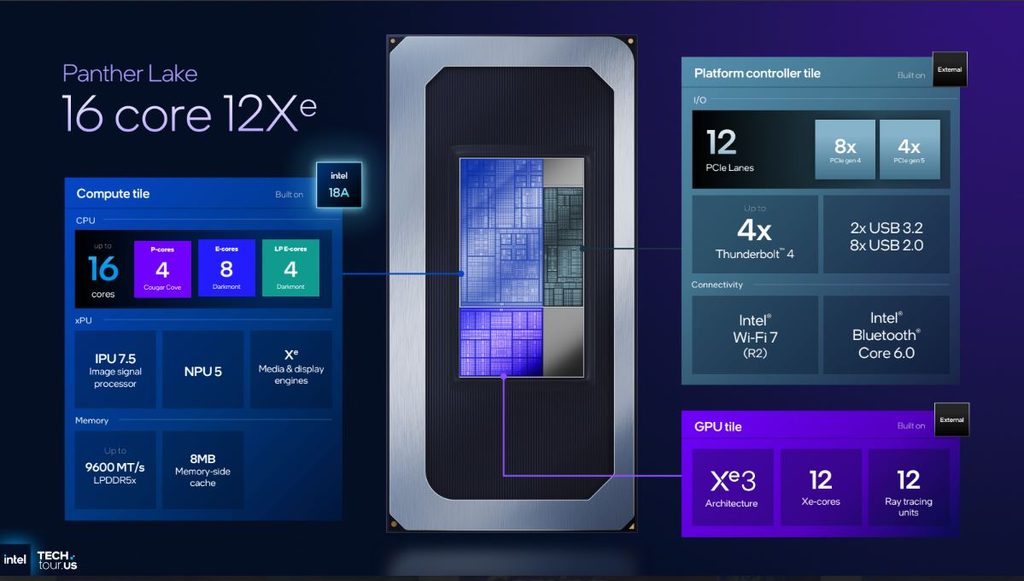
Synthetic testing on Geekbench shows noticeable divergence across different workloads. Intel’s Core Ultra X9 388H produces 2,660 in single-threaded tests and 15,784 in multi-core performance. The Ultra X7 358H logs 2,585 in single-threaded runs and 17,261 in multi-core runs. In single-core testing, the baseline M5 holds a clear lead over both Intel parts. Apple’s 13-inch MacBook Air models score 3,573, while the 15-inch model reaches 3,584. Multi-core results remain much closer, spanning from 17,048 on the two 13-inch Air systems to 17,172 on the 15-inch chassis. Early MacBook Pro machines shipping with baseline M5 processors deliver higher marks, achieving 3,643 in single-core and 17,959 in multi-core tasks. In single-threaded speed, Apple’s entry M5 also tops Intel’s premier desktop chip, the Ultra 7 270K Plus, which reaches 2,933.
Desktop comparisons for the Apple M5 Pro
When evaluating the Apple M5 Pro, the only practical Intel equivalent is the Ultra 7 270K Plus. According to Geekbench and other synthetic benchmarks, the 270K Plus is Intel’s highest-performing processor, producing 2,933 in single-core and 27,402 in multi-core metrics. The M5 Pro registers distinct scores depending on system cooling and form factor. Single-core results outpace Intel by wide margins across every model, showing 3,679 on the 14-inch MacBook Pro and 3,692 on the 16-inch version.
In multi-core workloads, Intel trails most M5 Pro models. The entry 15-core M5 Pro scores 29,568, which sits close to the 27,402 result of the Ultra 7 270K Plus. The 18-core M5 Pro stretches that gap, reaching 33,433 in the 14-inch MacBook Pro and 33,598 in the 16-inch chassis. Intel currently provides no desktop or mobile chip that matches those 18-core M5 Pro multi-core totals. Achieving comparable multi-threaded numbers on an x86 architecture requires crossing over to AMD’s workstation ecosystem, where the Ryzen Threadripper Pro 9965WX logs a multi-core score of 32,222.
Limits of equivalence for the M5 Max and Ultra
Intel offers no direct answer to Apple’s M5 Max or M5 Ultra processors. The M5 Max in the 16-inch MacBook Pro yields 3,731 in single-core and 35,120 in multi-core testing. Those numbers decline slightly on the 14-inch MacBook Pro, recording 3,691 in single-core and 34,535 in multi-core because the smaller chassis throttles clocks to manage operating temperatures, or when buyers configure lower-tier chip variations. Beyond the Max tier, early benchmarks for the M5 Ultra record 3,774 in single-core and 52,516 in multi-core. That multi-core figure surpasses Apple’s previous-generation M3 Ultra and marks one of the highest scores documented on Geekbench.
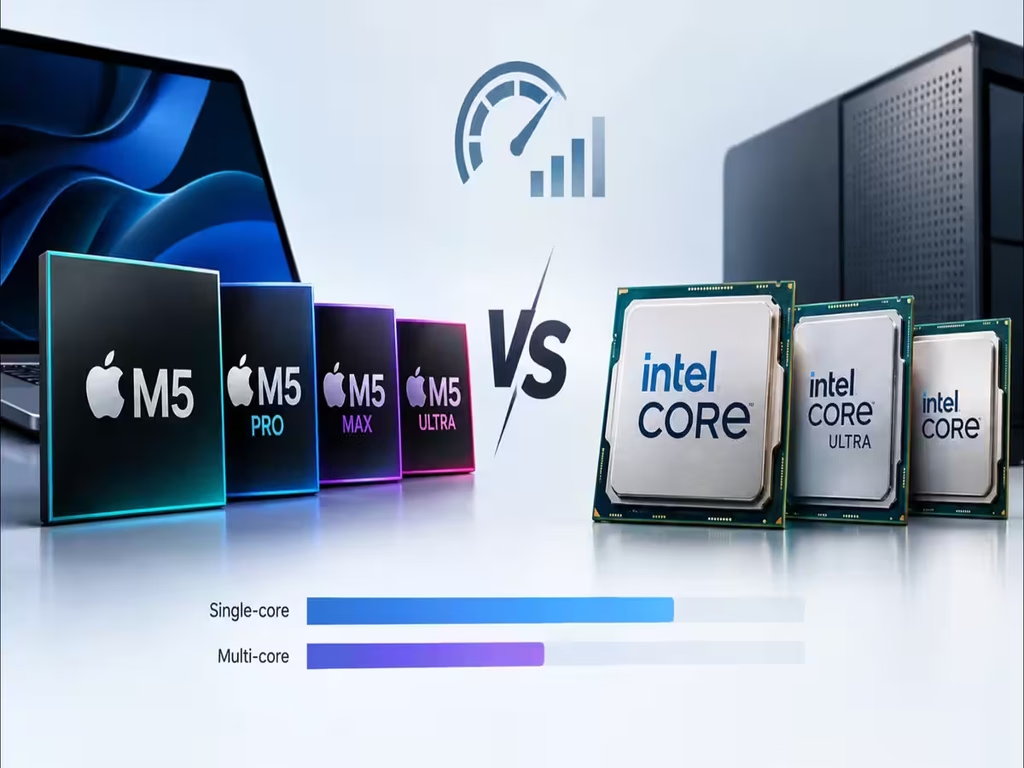
Intel’s upcoming developments focus primarily on portable form factors. The company’s Panther Lake and Wildcat Lake chips target the mobile and laptop sectors, delivering substantial gaming gains for handheld PCs. Its next generation of major desktop processors remains on the horizon. At the same time, Apple is moving ahead quickly, with early baseline M6 benchmark figures reaching 4,071 in single-core and 22,783 in multi-core testing. For now, direct Intel parity with Apple’s M5 family exists only when pairing baseline laptop chips against the Core Ultra series or matching desktop silicon against specific M5 Pro models.
Editorial Ethics & Disclosure: Our evaluations, reviews, and reporting are conducted independently. Learn more about our editorial ethics and affiliate disclosures.

About Robert Haba
Robert Haba covers technology, hardware architectures, and consumer platforms for Gadgetts.
Related Coverage
 Laptops & PCs
How a $10 bootable USB drive can rescue a failing PC
A $10 bootable USB drive can recover an unbootable PC. Learn how to configure Ventoy with Windows or Linux ISO files and portable repair tools.
 Laptops & PCs
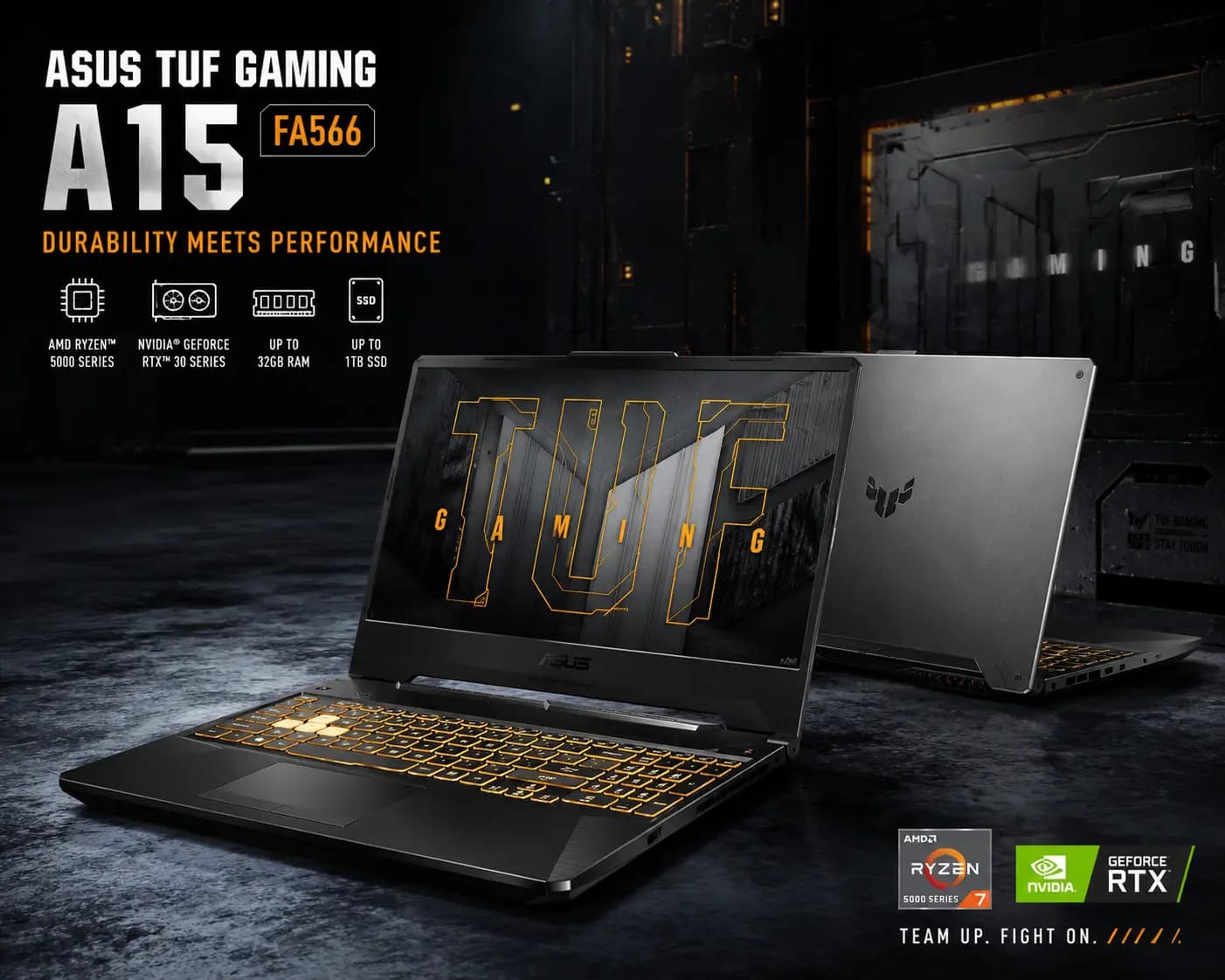
Asus TUF Gaming A15 2026 arrives with Ryzen 7 170 and RTX 3050
The Asus TUF Gaming A15 2026 lists for ₹97,990 on Amazon with an AMD Ryzen 7 170 chip, RTX 3050 graphics, 16 GB DDR5 RAM, and a 144 Hz FHD display.
 Laptops & PCs
HarmonyOS PCs Get a Major Boost as Linux Tools Now Run Natively
Thanks to a new tool, Huawei announced today that HarmonyOS laptops may now run Linux-based programs and tools natively. This is significant news for its in-house computer operating system since it gives developers more options. Huawei launched the Converged Development Engine in the HarmonyOS PC AppGallery on April 1. The 1.0.0.17 version is in the