


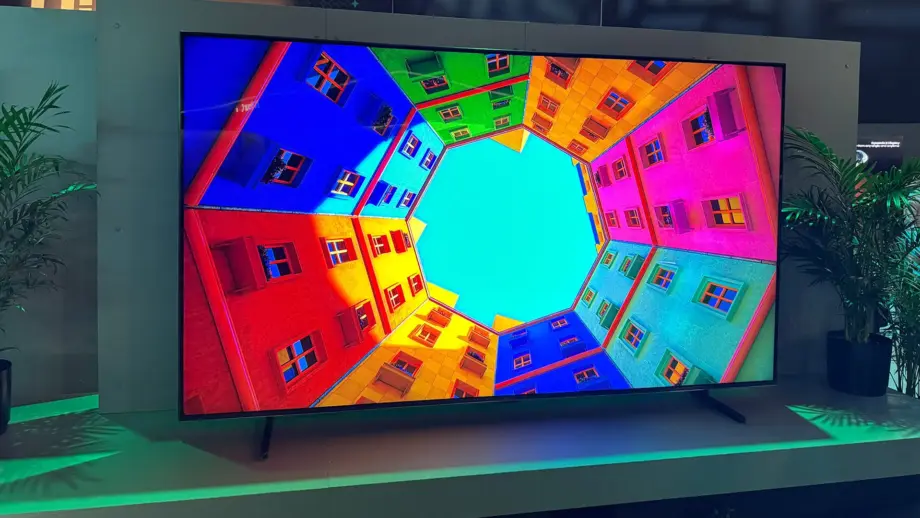
Not long ago, TV display technology felt like it had hit a plateau. Now it’s moving fast enough that even professional analysts are struggling to keep pace. Quantum dots — tiny nanoparticles that amplify brightness and color — pushed things forward. Multi-stacked OLED panels followed, ramping up the performance of self-emitting screens. Today’s televisions are brighter, more colorful, and more capable than at any point in consumer history.
Now another technology has entered the picture. It’s a new kind of LED lighting system called RGB LED, and its core advantage comes down to color at the source. Last year, a visit to Sony’s labs in Japan offered an early look at the technology in its formative stages. With consumer-facing screens now arriving in force, here’s a closer look at what RGB LED actually is and where to find it in 2026.
What Is RGB LED?
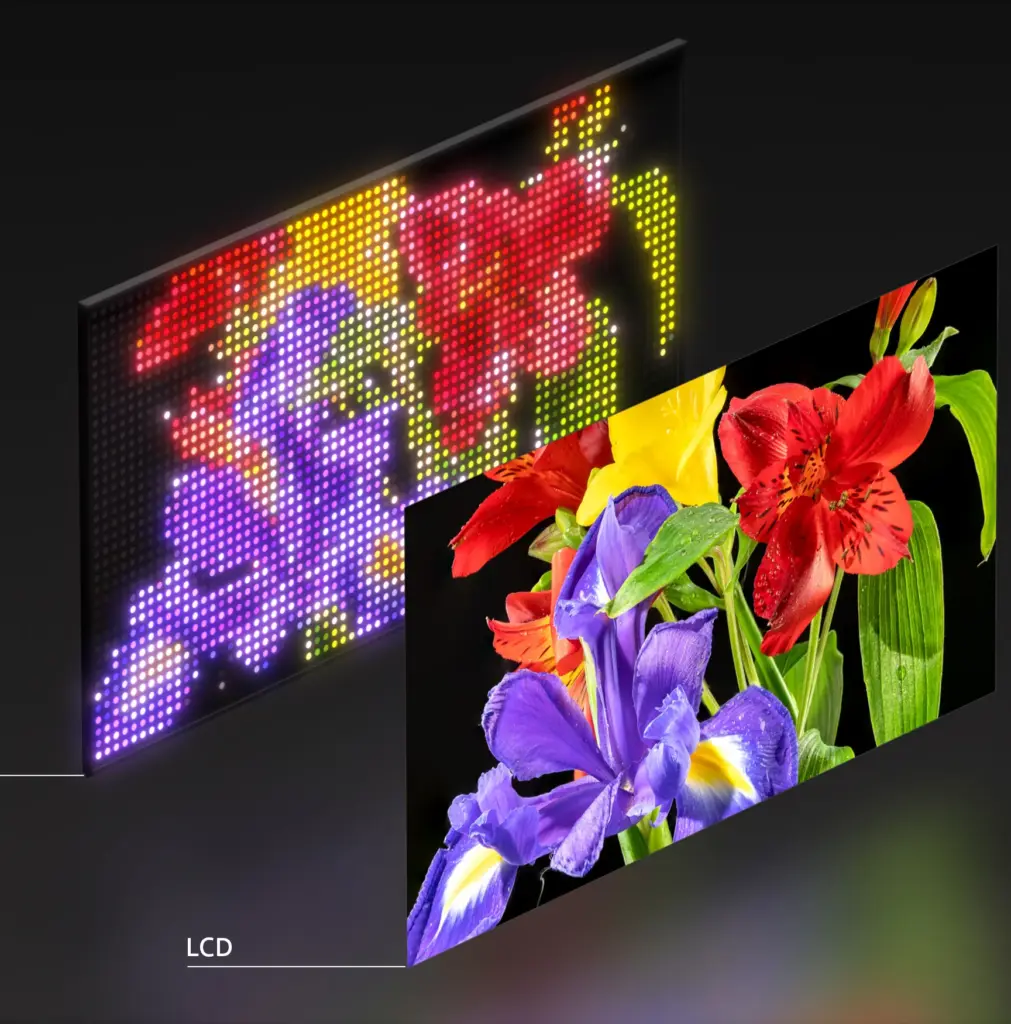
It starts with the backlight. Traditional LED TVs use white or blue LED backlights that shine through color filters and an LCD panel to produce bright, colorful images. The best of these use quantum dots for richer colors, multiple dimming zones — known as local dimming — and increasingly small LEDs called mini-LEDs to push brightness higher and reduce light bleed. Even so, they still produce noticeable glow around bright objects, which limits contrast compared to emissive technologies like OLED, where each of the screen’s millions of pixels generates its own light against a perfectly dark background.
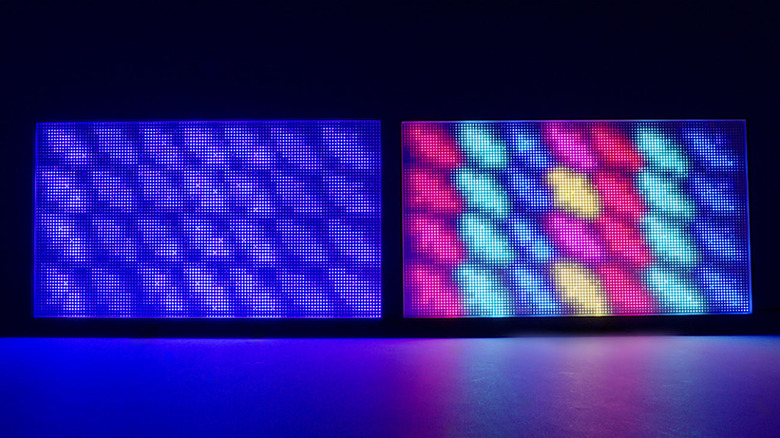
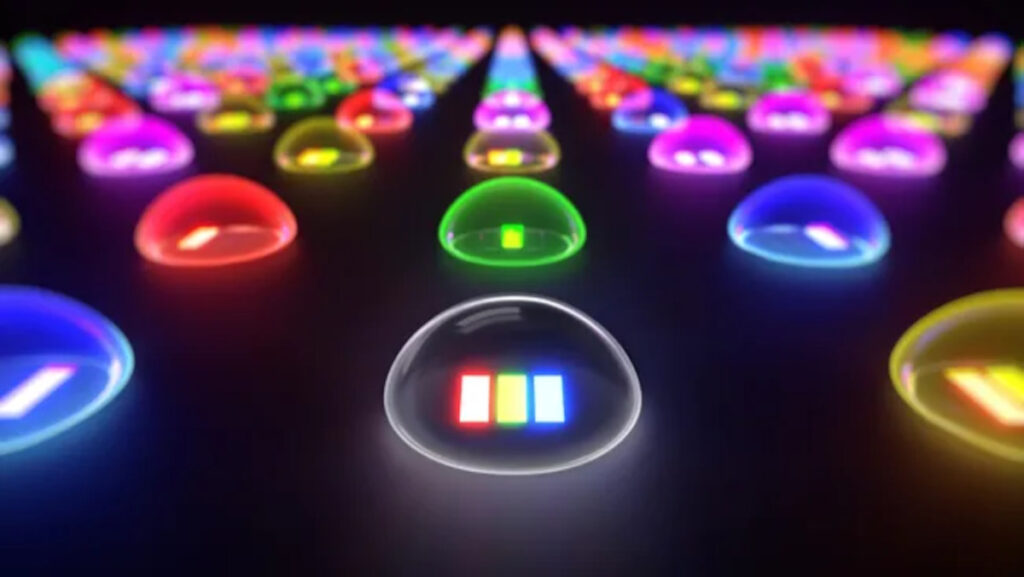
RGB LED panels follow a similar principle to conventional LED TVs, but instead of white or blue backlights, they use thousands of red, green, and blue LED modules to produce colors directly at the light source. Hisense, one of the first brands to release an RGB LED TV, describes this as the ability to generate “pure colors directly at the source.” Combined with color filters, this approach is said to unlock a significantly wider color gamut than traditional LED, alongside tighter backlight control and reduced light bleed for improved contrast. Hisense calls this method “RGB local dimming,” distinguishing it from conventional LED-based local dimming.
RGB LED TVs from Hisense, Samsung, and LG are claiming color accuracy reaching 95 to 100 percent of the BT.2020 color gamut — a next-generation color standard. Sony’s RGB LED prototype, seen in its Tokyo labs last year, claims around 90 percent of the same spectrum. By comparison, most traditional LED and OLED TVs tested today top out at roughly 80 to 85 percent of BT.2020, with many falling well below that. Whether these figures translate meaningfully to real-world content is still an open question — content mastered for BT.2020 remains limited, and it’s unclear how well those specs will hold up outside controlled demonstrations.
That said, in the limited time spent with these panels at CES and at Sony’s labs, RGB LED’s advantages over traditional LED in contrast, blooming control, off-axis performance, and color saturation were genuinely impressive. It still can’t match OLED’s deep blacks or granular contrast, but RGB LED carries another significant advantage: raw brightness, and a lot of it.
RGB vs. OLED and QLED: The Brightness Wars
OLED remains the benchmark for outright picture quality. Its combination of perfect black levels, near-infinite contrast, strong off-axis viewing, and wide color coverage powers the best televisions available today. But OLED has a ceiling when it comes to brightness — and that ceiling is lower than what the best LED TVs can hit, let alone the new generation of RGB displays.
That’s not to diminish modern OLED panels. The latest 2026 flagship OLED screens from Samsung Display and LG Display claim peak brightness of up to 4,500 nits in small highlight windows. As with last year’s “4,000-nit” panels, real-world performance will likely be considerably lower — the top OLED panels from 2025 measured closer to 2,000 to 2,200 nits in standard testing — but that’s still a compelling result.
Traditional mini-LED TVs with quantum dots, commonly marketed as QLED, hold a notable edge in brightness. Accessible models regularly hit 4,000 to 5,000 nits peak brightness in real-world content, with some high-end configurations claiming even higher figures.
RGB LED TVs push further still, with current models claiming 8,000 to 10,000 nits peak brightness. Like their color gamut numbers, this far exceeds what content pipelines currently support — most streaming content is mastered to a maximum of 1,000 nits, and even the best Blu-rays cap out at 4,000 nits. Whether 10,000 nits is ever truly necessary outside the tiniest specular highlights is debatable, but higher peak brightness typically correlates with higher full-screen brightness, or Average Picture Level (APL), which still has meaningful headroom to improve.
RGB LED’s brightness also appears to contribute directly to its color accuracy. As Sony engineer Hugo Gaggioni put it, brightness when properly controlled “becomes a new color accuracy weapon” — and that philosophy is driving much of the current wave of panel development across the industry.
Sony takes its RGB argument a step further, highlighting what it calls superior color gradation control. The company says its RGB LED system “can achieve what is challenging for existing OLED panels: the expression of colors with moderate brightness and saturation” — meaning colors can remain accurate even in low-lit scenes. In a brief demo at Sony’s labs, the RGB LED panel clearly outperformed the previous Sony OLED flagship, the A95L, in color saturation. The OLED held its advantage in black levels and image sharpness, but the demonstration made a compelling case for what RGB LED can do.
There’s one more angle worth mentioning: burn-in. OLED’s organic compounds can degrade at different rates over time, creating potential variations in brightness and color with prolonged static-image exposure. Burn-in is increasingly rare in modern OLED panels and isn’t a concern for most viewers, but it remains a long-term consideration — particularly for heavy gamers where static UI elements sit on screen for extended periods. RGB LED sidesteps this issue entirely.
Micro RGB vs. Mini-LED RGB
Until recently, the word “micro” in TV display discussions referred almost exclusively to Micro LED — the self-emissive technology from brands like Samsung and Hisense that rivals OLED by controlling each of millions of pixels independently. Like OLED, Micro LED can achieve perfect black levels, but the technology is extraordinarily difficult and expensive to manufacture, with consumer models currently carrying eye-watering price tags.
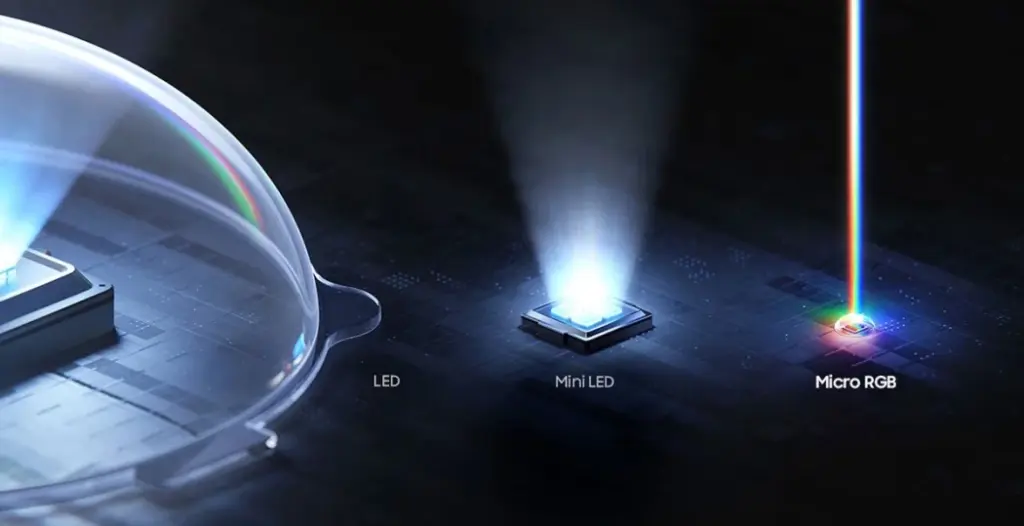
In the new RGB landscape, Samsung uses “Micro RGB” to describe something quite different: a non-emissive RGB backlight system that sits behind a liquid crystal display, like other RGB TVs. The distinction from traditional Micro LED is significant — Micro RGB is not self-emissive and cannot achieve the same perfect black levels. The key differentiator is scale: Samsung claims its RGB backlight modules measure less than 100 μm (microns) — smaller than the width of a human hair — making them smaller than the mini-LED clusters used in competing RGB designs.
LG also uses the term Micro RGB for its own RGB TV lineup announced ahead of CES 2026. LG describes its Micro RGB evo TV as using “countless micro RGB lights, smaller than MiniLEDs.” Just how much smaller these Micro RGB modules are compared to mini-LED RGB panels from other manufacturers likely varies depending on which specific products are being compared.
After seeing Samsung’s first Micro RGB TV at CES 2025, Lydia Cho, head of product for home entertainment at Samsung Electronics America, explained the technology: “Unlike conventional LED TVs that rely on white backlighting, this product uses micro-sized RGB LEDs to control each color independently. This results in sharper, deeper, and more vibrant colors than ever before.”
To be clear despite the naming overlap: Micro RGB displays are not self-emissive. They cannot achieve the same perfect black levels or granular contrast as true Micro LED or OLED. What they should offer is better contrast than conventional mini-LED rivals, as the smaller module size theoretically enables more dimming zones and more naturalistic color transitions. Samsung’s 2025 prototype left a strong impression in the brief time spent with it — the colors, clarity, and brightness were all striking. Samsung’s first Micro RGB TV is currently available in a 115-inch configuration for $30,000, with more accessible sizes expected in 2026.
What Is Four-Color RGB LED?
Just as the display industry was getting comfortable with RGB LED, Hisense raised the bar again. After bringing RGB LED backlighting into public view at CES 2025, the company used CES 2026 to unveil its 116UXS RGB mini-LED TV — adding a fourth color to the traditional red, green, and blue setup by introducing cyan.
“Cyan sits in the part of the spectrum where human vision is most sensitive to subtle changes,” Hisense explained in its press release, “and its addition allows the 116UXS to render gradients, tones, and transitions with a level of nuance that feels more natural and lifelike.” The TV claims 110 percent coverage of the BT.2020 color spec — surpassing even the already ambitious claims of standard RGB LED panels — and bundles a Devialet Opéra de Paris 6.2.2-channel audio system. Full details and pricing remain unknown, but a high price tag seems inevitable if and when it reaches consumers.
What About SQD LED?
TCL took a different approach at CES 2026, introducing a technology it calls Super Quantum Dot mini-LED, or SQD mini-LED. Debuting with the 85-inch X11L SQD mini-LED TV, the technology blends traditional blue mini-LED backlighting with newly formulated Super Quantum Dots and a new UltraColor Filter.
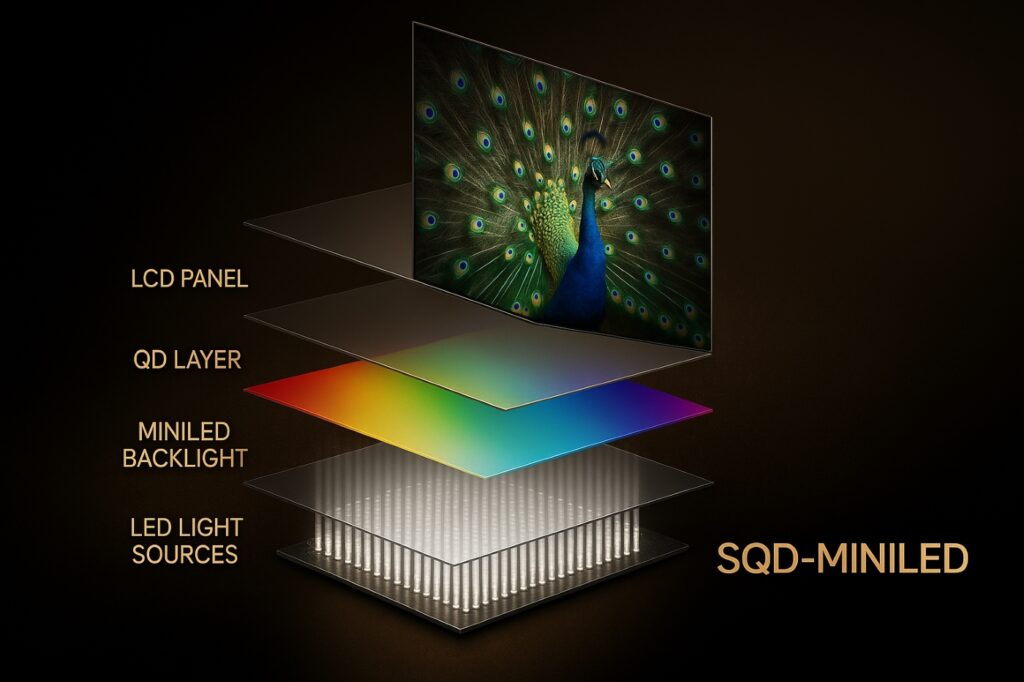
On paper, the X11L’s specs rival the most ambitious RGB LED TVs — up to 10,000 nits peak brightness and 100 percent of the BT.2020 color spectrum, though TCL notes the latter figure is “based on typical performance of tested units” with the caveat that “actual results may vary.” TCL also claims its SQD technology reduces color artifacts compared to RGB LED and that the X11L’s panel is engineered for a wide color viewing angle and enhanced contrast to better compete with OLED. The X11L made a significant impression at the show without an in-person viewing, and it positions itself as a serious alternative to RGB LED in a market that’s evolving quickly. The X11L SQD TV is available now in 75-, 85-, and 98-inch sizes, starting at $7,000.
RGB TVs You Can Buy in 2026
One of the most encouraging aspects of RGB LED is that it’s no longer a future concept — it’s already on sale. Hisense began selling its first RGB mini-LED TV in 2025, though only in enormous screen sizes with prices to match. That’s changing in 2026, with multiple RGB LED models targeting more manageable sizes and, hopefully, more accessible price points. That’s precisely why 2026 has been declared the year of the RGB LED TV. Here’s a rundown of the models known so far.
RGB LED TVs Available Now
Samsung 1st-gen 115-inch Micro RGB TV ($30,000) Samsung’s debut Micro RGB TV claims the smallest RGB backlight system available in any RGB LED TV, 100 percent BT.2020 coverage, a glare-free coating, and is driven by Samsung’s dedicated Micro RGB AI Engine. The brief time spent with the prototype confirmed impressive spectacle — bright, richly colored, and visually striking. At CES 2026, Samsung also unveiled a 130-inch Micro RGB TV in a distinctive form factor described as “the peak of our picture quality innovation,” though commercial availability details remain unconfirmed.
Hisense 116UX Series RGB Mini-LED ($20,000) Hisense’s mini-LED RGB TV was equally striking at CES 2025, reaching 95 percent of BT.2020 across more than 20,000 “color control units” and claiming up to 8,000 nits peak brightness.
RGB LED TVs Coming Soon
Samsung 2nd-gen Micro RGB TVs Samsung’s expanded 2026 Micro RGB lineup spans 55-, 65-, 75-, 85-, 100-, and 115-inch sizes — a range that should bring meaningfully lower price points. The new lineup features Samsung’s next-generation Micro RGB AI Engine Pro chipset, an upgraded light source with enhanced RGB color dimming for improved precision, and Samsung’s glare-free matte screen technology across all models.
LG MRGB95B Micro RGB Evo TV (75–100 inches) LG’s entry into the Micro RGB category, billed as its “most advanced LCD TV,” pairs an upgraded processor with claimed 100 percent coverage of BT.2020, DCI-P3, and Adobe RGB color gamuts.
Hisense UR8 and UR9 RGB Mini-LED TVs (55–100 inches) Designed to bring RGB LED backlighting to “more homes, more screen sizes, and more price points,” the UR9 and UR8 are shaping up to be the most accessible RGB LED TVs announced so far. Hisense describes them as proof of “what’s scalable,” and the hope is that pricing will land somewhere in the range of current premium OLED and QLED TVs — though no figures have been confirmed. Hisense says these models will deliver “dramatically expanded color range with richer saturation and more accurate tonal reproduction than standard premium TVs on the market.”
It’s still early for RGB LED displays, and it’s far too soon to write off competing technologies or OLED, which continues to push further than most expected. A great deal more will become clear over the course of 2026 — but what’s already evident is that the TV landscape is getting brighter, more colorful, and increasingly compelling at every price point.