

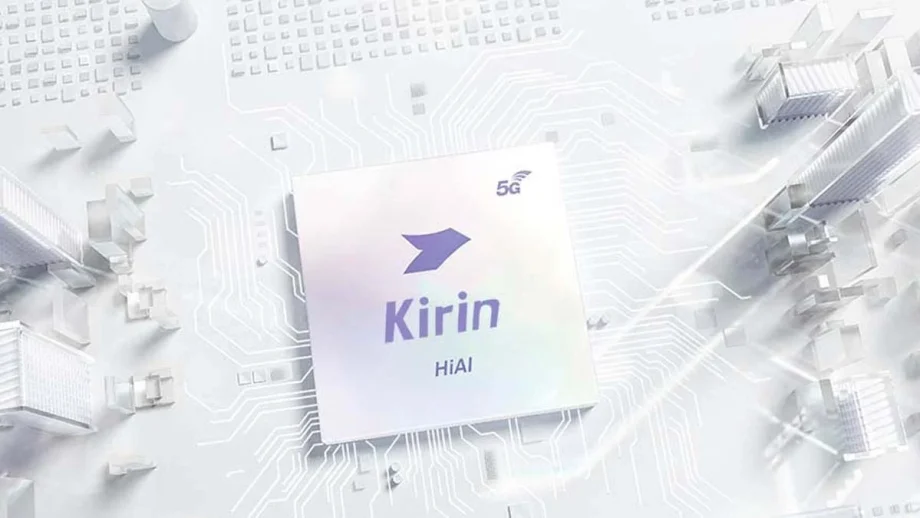
Huawei Semiconductor Business Unit President He Tingbo has presented an updated Tau Law paper detailing real-world Kirin 2026 test results, covering everything from heat dissipation to power consumption on the upcoming mobile chips.
According to Tingbo, the new chipsets show a 55% increase in transistor density, alongside a 66% cut in NPU power consumption. GPU and CPU power consumption dropped by 58% and 41%, respectively, compared to the Kirin 9030 Pro under matching performance conditions. Tingbo, the chief scientist behind the paper, attributed most of a chip’s energy consumption not to the computing process itself but to data transmission.
LogicFolding’s role in the results
The updated Tau Law paper puts particular focus on heat dissipation and power consumption, issues that became a hot topic following the introduction of LogicFolding. Under the traditional view, stacking active transistors vertically should raise power density and heat generation per unit area, but Huawei’s results with the Kirin 2026 series run counter to that expectation.
LogicFolding is said to maintain the same performance level in the Kirin 2026 chip while enabling 29 TPOS of computing power, a voltage reduction of 0.30V, and a 73% reduction in power density.
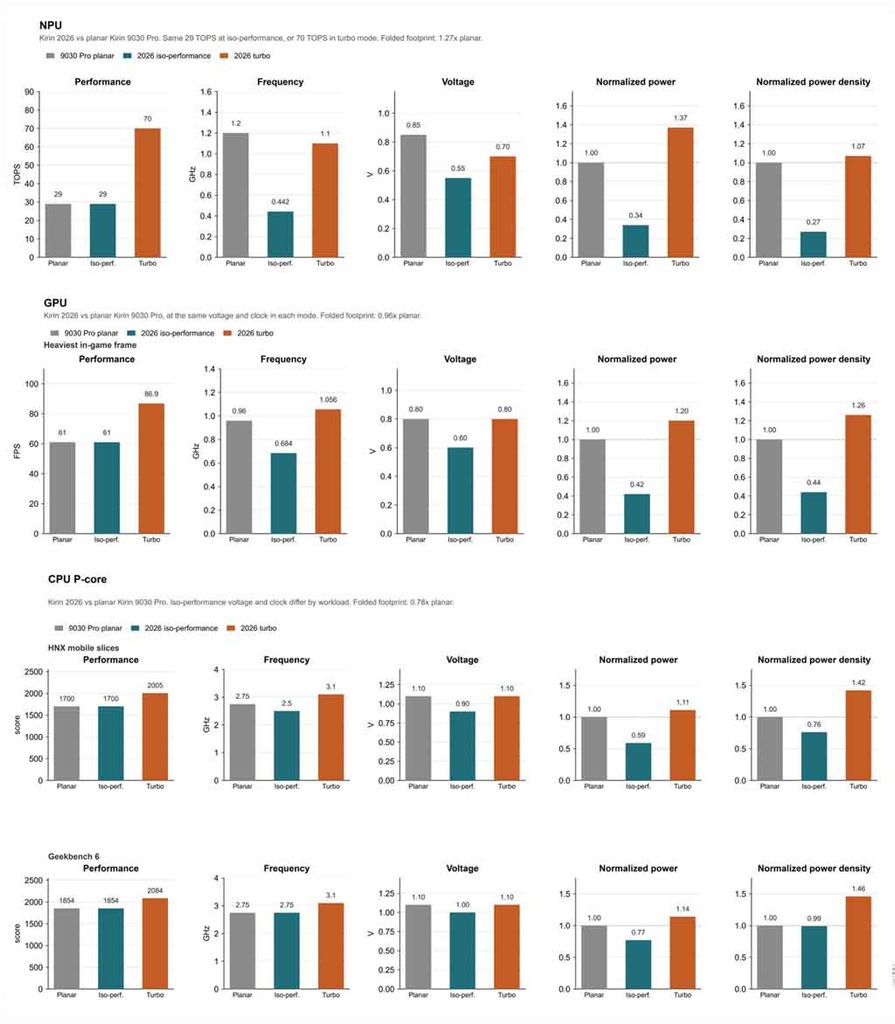
Test results by scenario
Huawei detailed the following results from its testing:
- 61 FPS condition: the GPU runs at 200mV lower than the Kirin 9030 Pro, cutting power consumption by 58%.
- HNX testing: the CPU matched the Kirin 9030 Pro’s performance while delivering an 18% improvement, a 9% lower frequency, 200mV lower voltage, and a 41% reduction in power consumption.
- Turbo Mode: the Kirin 2026 NPU reaches a maximum of 70 TPOS, a 141% improvement over its predecessor, while boosting GPU frame rate by 42%.
Additional measurements showed that typical core wiring length can drop by 20% after folding, shortening some critical data transmission paths by up to 70%, while clock wiring in processing modules is reduced by 28%.